

How does a used EV stack up for battery and range? We tested four to find out
5 Minute Read
Summary
- Used EVs show varied battery health and range due to age, mileage, and usage.
- Testing four popular models revealed significant performance differences under identical winter conditions.
- Jaguar I‑Pace achieved 341 km, outperforming Audi e‑tron and Tesla Model S.
Not everyone wants or has the opportunity to buy a new electric car. As many as 18 per cent consider a used electric car when buying a used car, according to a survey conducted by Norges Automobil-Forbund (NAF is CAA’s sister club in Norway).
Most people understand that there can be both wear and necessary maintenance on the horizon when buying a used car, regardless of the powertrain. But how the propulsion battery holds up in an electric car is still a concern for many. Is the battery "used up"?
How far can a used EV go?
We already know that studies indicate that electric car batteries last longer than the rest of the electric car. But in practice, it means the battery gradually loses some of its capacity.
How would it go if we let a selection of popular used cars compete on the same track as the new cars are driven during El Prix, NAF and Motor's big range test?
The criteria we chose the cars according to the following:
-
Theoretical range of over 300 km
-
At least 3 years old
-
Popular on the second-hand market
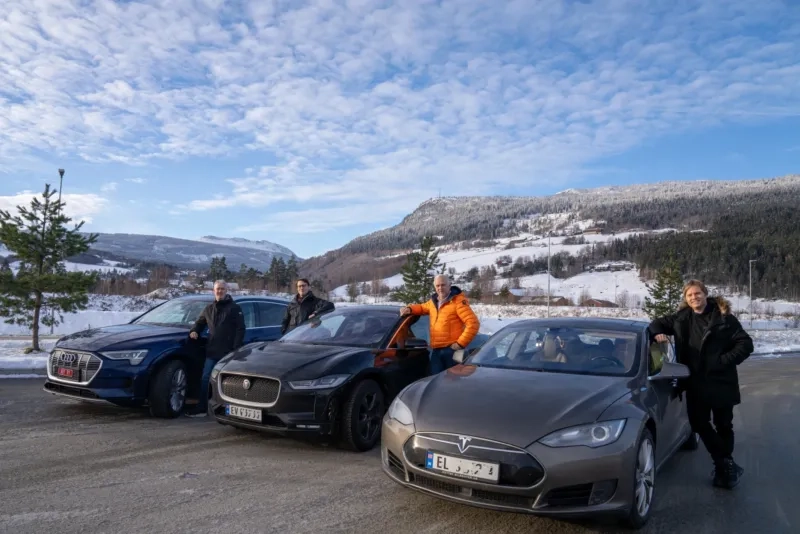
With us on the trip were a Jaguar I-Pace (100,000 km), a 2020 and a 2019 Audi e-tron 55s (44,000 km and 85,000 km, respectively), and a 2015 Tesla Model S 70D (100,000 km). The first three were from 2019/2020, while the Model S, as a 2015 model, was the test's old car.
A complex question
Before we dive into the numbers from the experiment, we need to take a look at all the reasons why this doesn't offer a definitive answer to how each car model holds up.
Mileage, charging history, and driving style are among the factors that can affect a car's condition, which is why it is very difficult to conduct a qualitative, comparable test of used electric cars. Each used car has its own unique usage profile.
This experiment must therefore be seen as an illustration of what can await you on the second-hand market. We wanted to show that there can be significant variation, even within the same car model.
How the cars performed
On the day of the experiment, the weather gods offered a varied buffet: snow and slush in parts, and temperatures from around 0 degrees to minus 8. The cars were driven until they had less than 10 per cent battery left, and consumption and remaining kilometres were recorded every 50 kilometres. Based on this, we estimated how far the cars would have gone if they had driven until the battery was at 0 per cent.
The 2019 Jaguar I-Pace went the furthest, with 341 kilometres, followed by the 2020 Audi e-tron 55 at 330 kilometres.
Compared to the cars' stated WLTP (World Harmonized Light Vehicles Test Procedure) range, however, it is the Audi that can boast the smallest deviation, with only 16 per cent shorter range than stated, compared to the Jaguar's 25 per cent. It is also worth noting that both are within the normal range for what we are used to seeing when we test brand-new electric cars in winter, where we often see up to 30 per cent shorter range than the stated WLTP range.
The second Audi E-tron was slightly shorter than the first, but here, too, it is necessary to see the connection to the stated range, explains car technical advisor at NAF, Tom Andre Nilsen.
"The difference between the two used cars is not as big when measured against their own official range. And both are well within the 20-30 per cent deviations from WLTP we have typically seen when we have tested electric cars on winter roads," he says.
The case of Tesla
Nevertheless, it was the experiment's most senior electric car, the 9-year-old 2015 Tesla Model S, that was responsible for the biggest surprise.
Measured against the stated range, the result, at first glance, does not look particularly impressive. But in 2015, the range was stated according to the significantly more optimistic NEDC standard. (In 2020, the NEDC standard was replaced by WLTP, which is stricter – with an estimated 20-25 per cent lower range estimate, depending on the car model.)
Apply current WLTP standards: by subtracting 20 per cent from the Model S's stated range of 442 kilometres, the theoretical deviation is only 12 per cent.
"A lot has happened in a very short time on the electric car front, and we in no way expected that an eight-year-old electric car would be able to measure up to electric cars that are half as old," says Nilsen.
However, he reminds us that an electric car is more than just range.
"You have to calculate more costs for maintenance, the older the car is. In addition, there has been a rapid development on the charging front in recent years, so newer cars will be able to have more efficient charging stops.
Take a holistic view of performance
Studies show that the electric car's battery holds up better than expected. We also know that battery degradation is often fastest in the first few years, then stabilizes for the rest of the battery's life, with a slight increase at the very end.
Although we cannot draw conclusions from the four cars included in the test, the results are a nice illustration of what you can expect from the used market.
It's also important to remember that a used electric car is more than just its range. Does it meet your load capacity and space needs? Has it kept up with the technological development in charging?
Test drive used EVs
Whether an EV or a gas vehicle, a test drive is critical for understanding not just power or fuel consumption, but also how it handles, the condition of the brakes, and the suspension.
Ask the seller about how far the car typically goes in summer and winter, the charging history, and their experience of fast charging in different settings. If they have kept records of warranty repairs, request a copy. Consider getting an EV mechanic to check it over, too.
Most of all, take your time to decide, adds Nilsen.
"It's easy to get 'caught up in the situation' when you're shopping for a car, and suddenly you're a car owner. In many cases, it goes well, but remember to take your time, don't stress or let yourself be stressed.”
How the experiment was conducted
The cars started from a warm garage, where they had been fully charged overnight. Every 50 kilometres, we noted consumption, battery percentage and remaining range. We also connected the cars to monitoring tools from an independent battery testing company, Aviloo. The cars were driven until they had 10 per cent battery capacity left. Our experts then used the consumption and battery percentage information to calculate how far the cars would have travelled if they had driven until their batteries reached 0 per cent.



