

How drivers, cyclists and pedestrians can keep kids safe on the way to school
3 Minute Read
Summary
- Drivers should slow down, avoid distractions and watch for children in school zones.
- Cyclists must signal turns, obey traffic rules and stay visible to prevent collisions.
- Pedestrians can enhance safety by using crosswalks and making eye contact with drivers.
Across Ontario, school zones become especially busy during drop-off and pick-up times, when traffic increases and more children are travelling at once. Drivers, cyclists and pedestrians are all moving through the same space, often in a short window of time.
That mix creates moments when visibility drops, decisions are made quickly, and small mistakes can have serious consequences.
The driver’s role in protecting children
Drivers have the greatest responsibility in school zones. Slowing down, staying attentive, and anticipating the unexpected are crucial for keeping everyone safe—especially since children may act unpredictably.
Know the speed limits and signage
Ontario school zone speed limits are typically reduced to 30 or 40 km/h, as indicated by posted signs. These limits may be in effect only during certain hours, or when flashing lights are active, so it's vital to always check the signage and adjust your speed accordingly.
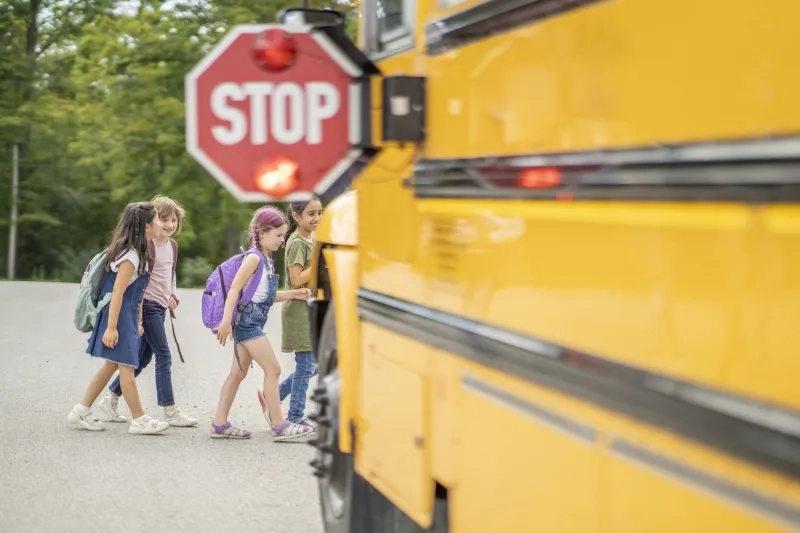
Remain vigilant for all posted signs, crossing guards, cyclists, and pedestrians, especially during busy times. When a school bus stops with red lights flashing and its stop arm extended, drivers in both directions must stop and remain stopped until the bus moves or the lights stop flashing.
Handling drop-off and pick-up safely
Drop-off and pick-up are the busiest moments in any school zone. Cars line up, people are often in a hurry, and sightlines can be blocked by parked or stopped vehicles. These conditions create the greatest risk of close calls, such as a child darting between cars or a crosswalk being blocked from view.
To help keep everyone safe, use designated drop-off areas, wait your turn, and avoid sudden stops in traffic. Practicing patience and vigilance during peak hours makes a real difference in protecting students and families.
Pedestrian and cyclist safety in school zones
Everyone using the road has a role in keeping kids safe, whether walking, cycling, driving, or commuting through a school zone. Parents and caregivers should help children build safe habits by discussing what to do before they set out and practicing the route together until these routines become second nature.
Rules for cyclists at crosswalks
Bicycles are considered vehicles under Ontario's Highway Traffic Act. Cyclists must follow the same rules as drivers: stop for school crossing guards and pedestrian crossovers, and yield the full roadway before proceeding. At crosswalks, cyclists should always dismount and walk their bikes across. This improves visibility and helps everyone anticipate one another's movements, making the school zone safer for all.
Tips for pedestrians
In busy school zones, avoid weaving through drop-off areas or around stopped vehicles. Stop at the curb, look both ways, and make eye contact with drivers before crossing. Do not run or dart into the street, and stay alert; distractions like phones or headphones can make it harder to spot danger.
At crosswalks, cyclists should always dismount and walk their bikes across. This improves visibility and helps everyone anticipate one another's movements, making the school zone safer for all.
How families can make the school commute safer
A safer school commute starts at home. Walk or drive the route together so your child knows where to cross and how to handle busy intersections. Choose routes with sidewalks and crosswalks, and avoid shortcuts through parking lots or between parked cars.
Practice the routine until your child feels confident. Remind them to always stop at the curb, look both ways, and make eye contact with drivers before crossing. Plan for extra time so there’s no need to rush, and encourage children to walk with siblings or friends when possible.
If your child takes the bus, review the safest way to wait—well back from the curb—and to wait until the bus stops completely before approaching. After getting off, they should look for traffic before crossing the street.
For families who drive, always use the designated drop-off area and avoid stopping in crosswalks or bus zones. Parking a short distance away and walking the last block together can ease congestion and set a good example for your child.
By preparing together and reinforcing safe habits, families help children build confidence and make safer choices on every school commute.
Supporting safer school communities
Keeping school zones safe is a shared responsibility. Drivers, cyclists, parents and pedestrians all play a role in creating a safer environment for children.
Programs like the CAA School Safety Patrol help support safe crossings and reinforce road safety habits for students across Ontario.


