

6 Unusual Canadian ideas that became big businesses
4 Minute Read
Summary
- Six featured Canadian companies grew from eccentric concepts into thriving consumer and service businesses.
- Profiles include Endy, SkipTheDishes, Knix, BIXI, Goodfood and 1-800-GOT-JUNK.
- Their success illustrates how unconventional ideas can achieve mainstream adoption and significant market impact.
We’ve all had one. That crazy business idea, get-rich scheme or solution to an unbelievably specific problem that feels like it could be the golden ticket. For most of us, these ideas never make it beyond the drawing board. Others take the risk, only for their big break to fizzle out. For the lucky few, however, that crazy idea - that nobody else really believed in - expands into something real. It becomes the entrepreneur’s dream come true and an inspiration to anyone who has ever imagined seeing their ideas on store shelves.
From roll-up mattresses to leakproof underwear and pre-packaged ingredients, here are six Canadian businesses that started with an unusual idea and grew into empires.
1-800-GOT-JUNK
https://www.instagram.com/p/DZm1XkWCcXA/?utm_source=ig_web_copy_link&igsi=NTc4MTIwNjQ2YQ==
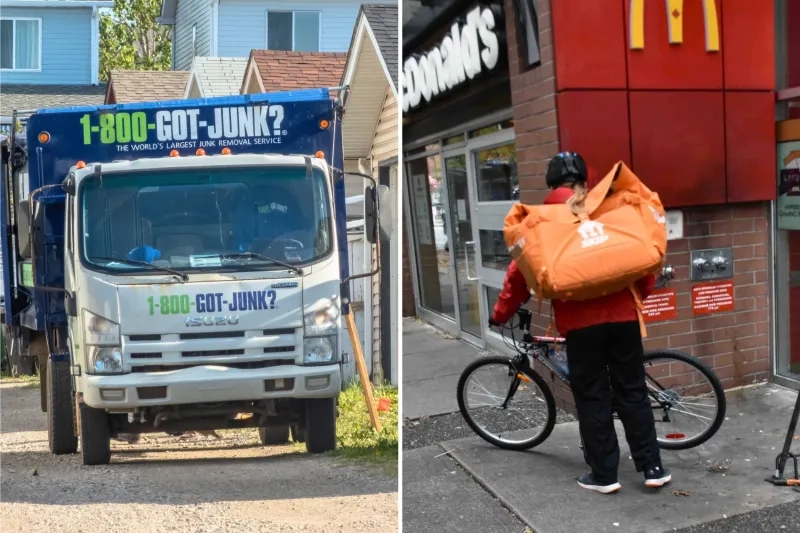
Perhaps the biggest success story on this list, the concept behind 1-800-GOT-JUNK may seem ubiquitous today, but was something of a revelation at the time. It all began in Vancouver in 1989 when founder Brian Scudamore spotted a beat-up truck offering junk removal services and thought to himself: “I can do better than that.”
The company has since blossomed into a network of more than a hundred franchises across Canada, the United States, and Australia, built around the simple premise of coming to people’s homes and hauling away what they no longer need - for a fee.
Still based in Vancouver, 1-800-GOT-JUNK has become a major Canadian success story, all stemming from the simple yet unusual idea of picking up after others.
Endy
Foldable, compact and transportable - not usually used to describe a mattress, especially if you’ve ever had to move one. Endy was founded in Toronto in 2015 by Calgary-raised entrepreneurs Mike Gettis and Rajen Ruparell with the idea of propelling mattress sales from showrooms into e-commerce.
The concept took off, thanks in no small part to the innovation that made Endy mattresses so easy to transport. Doing away with awkward hauling, Endy compressed, rolled up, and vacuum-sealed their products into compact boxes, which were shipped straight to customers' doors. Resolving an all-too-common problem, the idea's brilliance was obvious, with Sleep Country buying the company for $88.7 million just three years after its launch.
Knix
Unsatisfied by a lack of innovation in an underwear market that wasn’t catering to women’s needs, Toronto entrepreneur Joanna Griffiths founded Knix in 2013 - a line of leakproof underwear designed to support women through menstruation, bladder leaks and other everyday occurrences. Initially seen as a niche concept, Knix has since become a market staple, with the company valued at approximately $500 million in 2022, when it was acquired by the Swedish hygiene giant Essity.
BIXI
Surprising to those who don’t know its story, Montreal’s BIXI bike-sharing program is one of the most influential of its kind in the world. While bike-sharing programs were already entrenched in some European regions, BIXI introduced a unique combination of solar-powered docking stations, integrated payment technology and easily deployable infrastructure that revolutionized the field. BIXI technology has since laid the foundation for bike-sharing systems in cities including London, Washington, D.C., Melbourne, Boston and Toronto.
This Montreal-born idea of making bike rental as convenient as possible for both riders and city planners has redefined urban mobility worldwide. Initially developed and commercialized internationally by the Public Bike System Company, BIXI has grown from a local transportation experiment into a major Canadian export.
SkipTheDishes
Taken for granted today, the concept of a food delivery app was in its infancy when brothers Josh and Chris Simair launched SkipTheDishes in 2012. Founded in Saskatoon and later headquartered in Winnipeg, ‘Skip’ set out with the goal to make ordering food as simple as opening an app.
Today, SkipTheDishes has grown from a prairie start-up to a major competitor for international giants like Uber Eats and DoorDash - even having been acquired by UK conglomerate Just Eat for a deal worth $200 million in 2016.
Goodfood
Founded in Montreal in 2014 as Culiniste, Goodfood came into a world where grocery delivery and pre-planned meals were scarce. Driven by the goal of reducing food waste and making home cooking convenient for ordinary people, Jonathan Ferrari and Neil Cuggy began their journey by sourcing ingredients locally from Montreal’s famous Jean-Talon Market and packaging them with cooking instructions for their subscribers to prepare at home.
Just three years after its founding, Goodfood was listed on the Toronto Stock Exchange, with hundreds of thousands of active subscribers across Canada.
Make your big idea bigger
Every successful business starts with an idea, no matter how big or small. Whether at the start of your journey, or celebrating your success, a CAA Business Membership can help with major savings and benefits. Explore CAA Business Memberships today and give your company the support it needs.



