

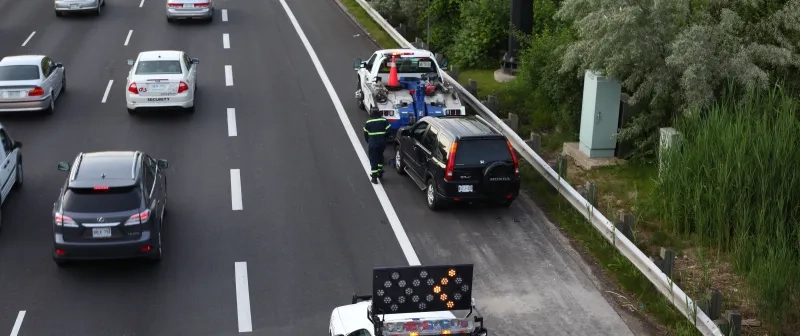
Flashing lights ahead? Here's what Ontario drivers often get wrong
2 Minute Read
Summary
- Ontario’s Slow Down Move Over law requires reducing speed and creating space for stopped emergency and tow vehicles.
- Rules apply to police, ambulances, fire trucks and tow trucks with flashing lights on the roadside.
- Violations can lead to fines, demerit points and licence suspension, with enforcement rising across the province.
An ambulance on the shoulder, lights flashing, helping in an emergency.
Most drivers know they should slow down. What some find less clear is when to change lanes, what to do if traffic is too heavy to move over safely and whether the law applies to tow trucks.
Ontario's Slow Down Move Over law is designed to protect emergency personnel and roadside workers. Understanding how it applies in everyday driving situations can help keep everyone safer.
Slow Down Move Over applies to more than police vehicles
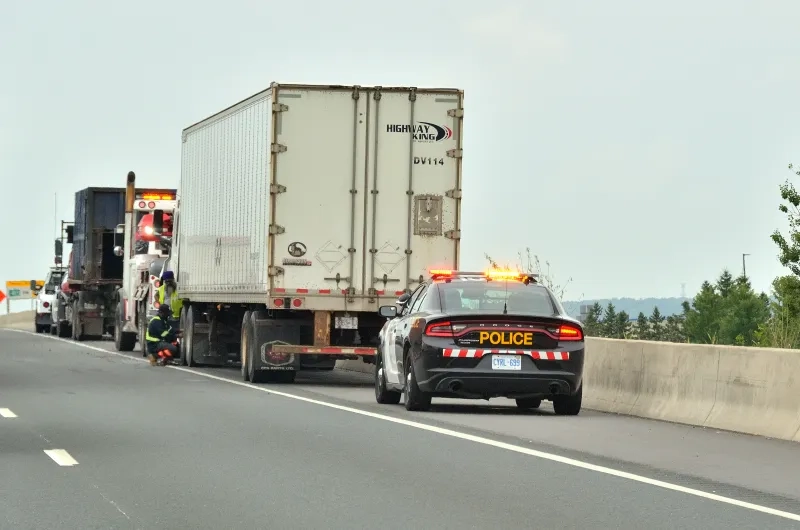
Many drivers associate the law with police or ambulances, but it also applies to tow trucks stopped with flashing amber lights. Ontario expanded the legislation in 2015 to include tow truck operators following advocacy from CAA and other road safety partners.
Moving over isn't the only requirement
Changing lanes is only part of the law.
Drivers who encounter a stopped emergency vehicle or tow truck with flashing lights must reduce their speed and pass with caution. When it is safe to do so, they should also move over to create additional space for roadside workers. If traffic or road conditions make it unsafe to change lanes, drivers must still slow down and proceed carefully.
Drivers can face significant penalties
Failing to comply with Ontario's Slow Down Move Over law can result in fines ranging from $400 to $2,000 for a first offence, three demerit points and a possible driver's licence suspension.
Enforcement continues across the province. Ottawa Police reported 32 tickets and 67 warnings in the first six months of the year. There were 240 investigations of HTA Section 159(3) “that requires drivers to move into another lane, if safe, when passing a stopped emergency vehicle or tow truck with its lights activated” on provincial highways in the City of Ottawa from January 1, 2025, to December 31, 2025.
Roadside workers aren't only at risk in bad weather
Many drivers assume roadside incidents occur during storms, periods of poor visibility, or other challenging driving conditions. Research suggests otherwise.
Most roadside assistance provider fatalities occur on higher-speed roads, particularly those with limits above 88 km/h. They also tend to happen in clear or dry conditions and often after dark, according to a 2024 AAA study supported by CAA.
The same research found that many of the drivers involved had previous violations, licence suspensions or crash histories.
Awareness doesn't always translate into action
Across North America, tow truck drivers face significant risks of being struck by passing vehicles while assisting stranded motorists.
A 2023 study by AAA, supported by CAA, found that 20 per cent of line-of-duty deaths involved tow truck drivers, yet only three per cent of those deaths received media coverage. The need for continued awareness was underscored in December 2025 when two CAA contractors in Ontario lost their lives in separate incidents while assisting stranded motorists.
When you see flashing lights at the roadside, slow down, move over when it's safe and give roadside workers the space they need to do their jobs safely. Whether they're police cruisers, ambulances, firefighters, or tow truck operators, the people working on the shoulder depend on drivers to help create a safer roadside environment.


